Getting the Whole Class Playing on One Interactive Whiteboard
One board, thirty pupils: how to organize teams and turns so that everyone is thinking during the game.
Read the articleWhy pupils add every number in the problem, and how to teach them to understand the situation before calculating.
Faced with a word problem, some pupils grab the numbers and look for something to do with them. They can calculate, but they haven’t built a picture of the situation. The work is to shift their attention: first understand, then calculate.
“In all” doesn’t always mean addition, and “fewer” doesn’t always mean subtraction. Take this problem: “Salma has 24 marbles in all. 9 are blue and the rest are red. How many red marbles does she have?” The words “in all” don’t change the fact that you have to subtract.
A pupil who only looks for words will find the right operation in easy exercises, then fail as soon as the wording changes. It is better to ask them to tell the problem in their own words.
Drawing a situation helps pupils understand it. A few simple diagrams are enough for most elementary school problems.
With one bar for each amount, the pupil can see where the unknown is, and the operation becomes clearer.
During one lesson, ask pupils only to choose the operation and justify the choice, without calculating. Fast calculators no longer get ahead, and everyone focuses on meaning. One simple question restarts the thinking: “Will the answer be bigger or smaller than the numbers in the problem?”
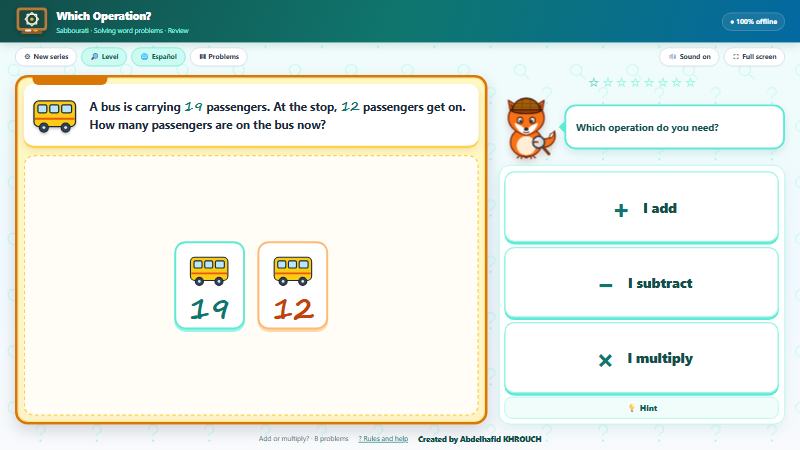 Which Operation?Read the problem, choose the operation, then calculate. One-step and two-step problems.See the game
When a problem has two steps, many pupils stop after the first. Teach them to turn it into two questions: “What do I need to know first?” and then “What can I find next?” Write both questions on the board before any calculation.
Ask for a complete sentence that includes the unit: “Salma has 15 red marbles.” This makes pupils go back to the question and often lets them spot an absurd answer on their own.
One board, thirty pupils: how to organize teams and turns so that everyone is thinking during the game.
Read the articleSwapped hands, the wrong hour, misread minutes, 12-hour or 24-hour time, durations: five classic mistakes and practical ideas for the classroom.
Read the articleNeatly upright lines hide the real concept. How to help pupils identify and check parallel and perpendicular lines.
Read the article