Word Problems: Learning to Choose the Operation Before Calculating
Why pupils add every number in the problem, and how to teach them to understand the situation before calculating.
Read the articleOne board, thirty pupils: how to organize teams and turns so that everyone is thinking during the game.
A game on the interactive whiteboard draws every eye in the room, but it doesn’t necessarily get the whole class working. Two pupils touch the screen and the others watch. A few organizational choices are enough to give everyone something to do at every moment.
Prepare the teams in advance and balance them, with confident and less confident pupils in each group. Forming groups in front of the class takes time and singles out whoever is picked last.
Two to four teams are enough. With more, each pupil waits too long for a turn. Give each team a fixed place in the room and keep the same groups for a few lessons: pupils get used to them and the start becomes quick.
The main risk is simple: the strongest pupils volunteer every time. So announce the order before you start, for example by following the rows or a posted list.
This is the decisive point. Every seated pupil works out the answer on a mini whiteboard at the same time as the pupil at the board. Ask for the boards to be held up from time to time: you get an instant picture of the class, and nobody is just a spectator.
In an observation game, give the waiting teams a job: spot the traps, count the right answers, or explain a mistake at the end of the round.
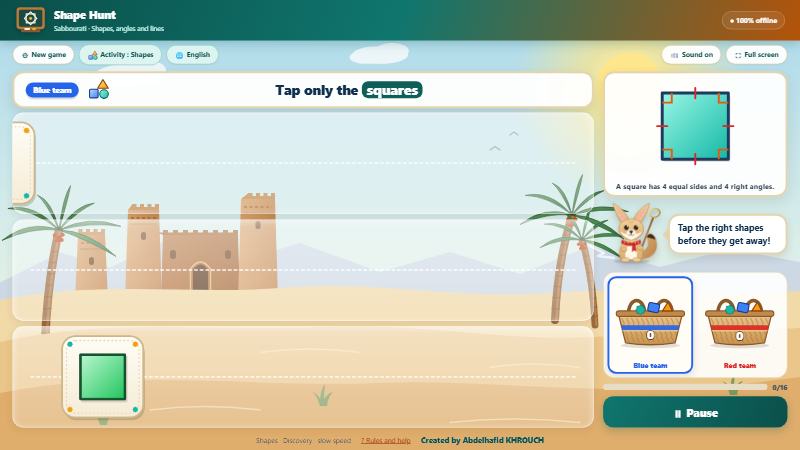 Shape HuntShapes scroll along three lanes. Tap the right ones before they get away.See the game
Repeat them before the first game, then refer back to them as soon as things get noisy.
The first game is mostly for understanding how it works. Choose a simple level and a short length. Once the rules are clear, you can raise the difficulty.
The most useful moment comes after the game. Go back over two or three mistakes: what fooled the team? How can we check next time? Then have pupils write an example in their notebooks, so the game leaves a trace.
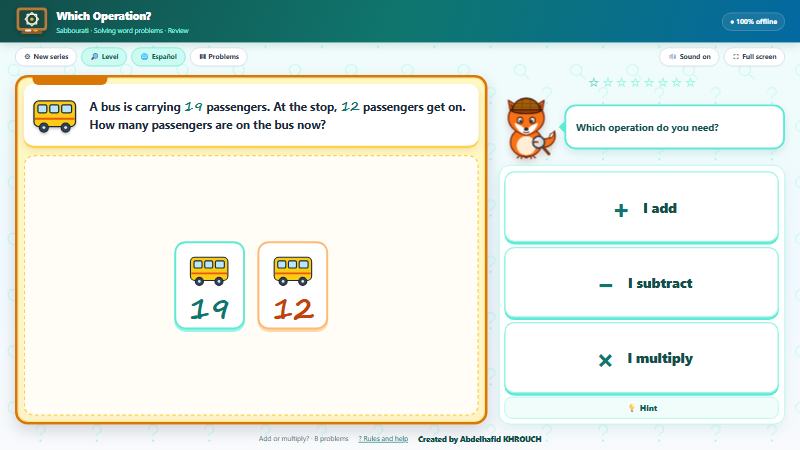 Which Operation?Read the problem, choose the operation, then calculate. One-step and two-step problems.See the game
Why pupils add every number in the problem, and how to teach them to understand the situation before calculating.
Read the articleSwapped hands, the wrong hour, misread minutes, 12-hour or 24-hour time, durations: five classic mistakes and practical ideas for the classroom.
Read the articleNeatly upright lines hide the real concept. How to help pupils identify and check parallel and perpendicular lines.
Read the article