Word Problems: Learning to Choose the Operation Before Calculating
Why pupils add every number in the problem, and how to teach them to understand the situation before calculating.
Read the articleNeatly upright lines hide the real concept. How to help pupils identify and check parallel and perpendicular lines.
Many pupils can identify two parallel lines in their textbook, then fail as soon as the figure is turned. The difficulty lies less in the words than in the mental images built from a few very similar examples.
If perpendicular lines are almost always drawn with one horizontal and one vertical line, pupils remember the position and not the relationship. As soon as both lines are tilted, they no longer recognize them. In the same way, two horizontal lines look parallel without any checking, while two slanted ones seem much less so.
So vary the orientations from the start. A single figure, drawn on a sheet of paper that you rotate, shows that the relationship doesn’t change when the position does.
Another misunderstanding: “they don’t cross, so they’re parallel.” In a drawing, two lines may seem never to meet simply because the drawing stops. Have pupils extend the lines with a ruler, or measure the gap in two places. If it changes, they will eventually cross.
The aim is for “by eye” to stop being an acceptable answer: every statement should be something you can check.
A window frame, the rungs of a ladder, a crosswalk: the environment offers plenty of examples. Ask pupils to find a pair of parallel lines and a pair of perpendicular lines in the classroom, then to prove it with a set square.
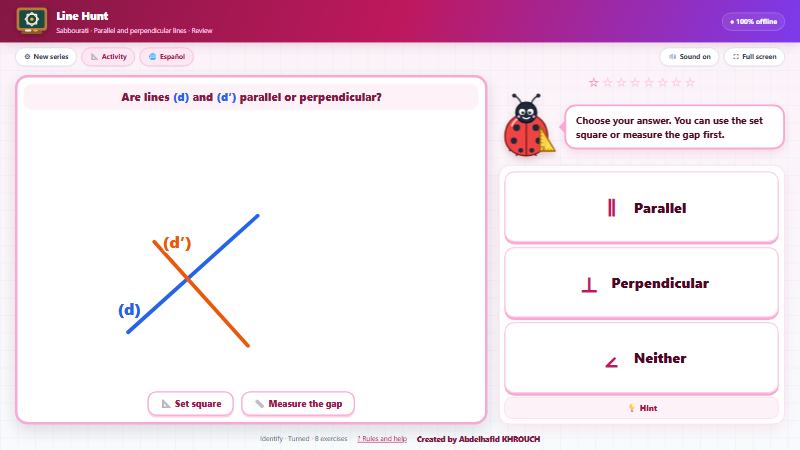 Line HuntIdentify and draw parallel or perpendicular lines, with a virtual set square.See the game
Drawing comes last because it depends on understanding the relationship. A pupil who still mixes up the two ideas will gain nothing from doing more constructions.
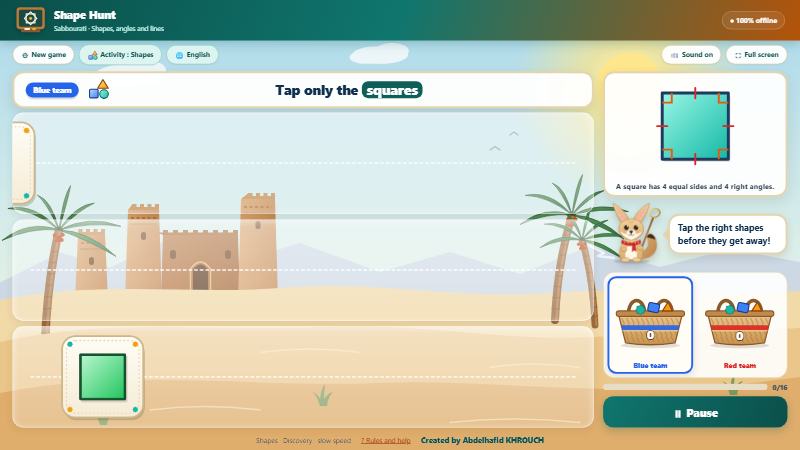 Shape HuntShapes scroll along three lanes. Tap the right ones before they get away.See the game
Why pupils add every number in the problem, and how to teach them to understand the situation before calculating.
Read the articleOne board, thirty pupils: how to organize teams and turns so that everyone is thinking during the game.
Read the articleSwapped hands, the wrong hour, misread minutes, 12-hour or 24-hour time, durations: five classic mistakes and practical ideas for the classroom.
Read the article